The House Astrologers Check First When Someone Asks About Marriage
Jul 16, 2026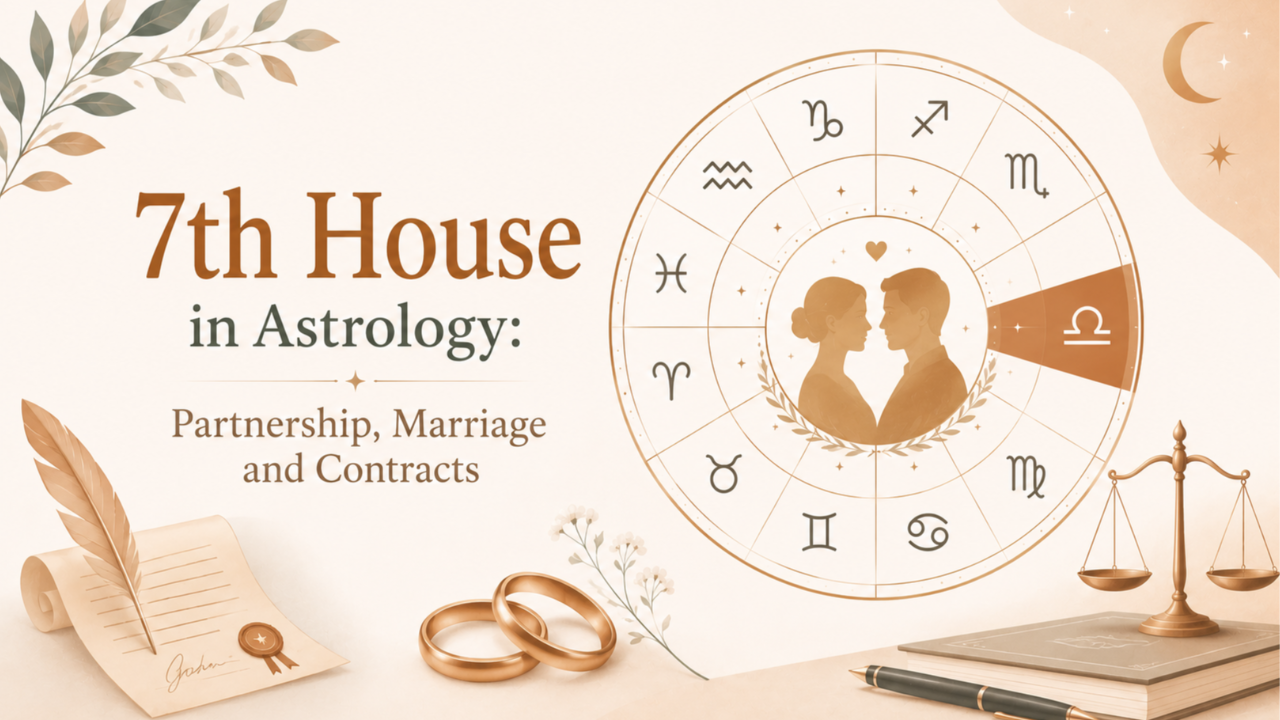
The 7th house is the section of your birth chart tied to marriage, business partnerships, and any one-on-one bond outside your family. Its sign and ruling planet describe the type of partner you're drawn to and the pattern your close relationships tend to repeat. A planet sitting inside this house adds its own tone, sometimes steady, sometimes tense, to how you show up once you commit.
Introduction
Why does one friend keep landing calm, dependable partners while another cycles through drama every few months? Astrologers look at the 7th house for part of that answer. It's the piece of the birth chart built around commitment, contracts, and the people you face directly, whether that's a spouse, a business partner, or a named rival. This piece covers what the 7th house rules, how its sign and ruler shift the reading, and how to interpret planets that land inside it. By the end, you'll know how to find your own 7th house and read it without guessing.
What the 7th House Actually Represents
Every birth chart splits into twelve houses, and the 7th sits directly across from the 1st, on a point called the Descendant. Where the Ascendant describes how you walk into a room, the Descendant describes who you look for once you're inside it. This self-versus-other axis dates back to Hellenistic astrology, practiced across Alexandria and the wider Mediterranean roughly two thousand years ago, and modern astrologers still lean on the same split.
Older texts hand the 7th house a wide job. William Lilly's 1647 manual Christian Astrology used this house for lawsuits and open disputes, not only romance. In Vedic astrology, practiced across India, the house carries the Sanskrit name Kalatra Bhava, tied specifically to spouse and the timing of marriage. Western sun-sign astrology tends to flatten all of this down to "the love house," which misses most of what the house does.
Common threads across traditions include:
- Marriage and long-term romantic commitment
- Business partnerships and joint ventures
- Legal contracts, negotiations, and lawsuits
- Open rivals, meaning competitors you know by name
- Client, consultant, and advisor relationships in modern readings
A client named Maria, a marketing consultant based in Austin, once asked why every serious relationship of hers turned into a business collaboration too. Her chart showed Libra on the 7th house cusp with Venus tucked inside it, a placement that often draws people toward partners who double as creative or professional allies rather than purely romantic ones.
The Descendant, the Cusp, and the House Ruler
The Descendant sits exactly 180 degrees from the Ascendant, and the sign resting on that line becomes the natural ruler of your 7th house. If Libra falls on the cusp, Venus rules the house; if Aries falls there instead, Mars takes over, and the reading shifts toward more direct, competitive partnership dynamics. The ruling planet's own sign, house, and aspects then color how that partnership energy actually plays out day to day.
House systems change where the cusp lands, and astrologers don't all agree on one method. Placidus, the system built into most software including Astro.com and Solar Fire, divides the chart unevenly based on time and latitude. Whole sign houses, used in Hellenistic Greek astrology and still standard in Vedic Jyotish, simply assign one full sign to each house. Equal house astrology splits the wheel into twelve clean 30 degree segments starting from the Ascendant. A birth chart calculated with two different systems can shift a cusp by several degrees, occasionally enough to change which sign rules the house entirely.
The 7th House by Zodiac Sign
The sign on the cusp shapes the flavor of partnership someone tends to attract, though the house's planetary contents still matter more than the sign alone.
- Aries on the cusp: partners who are direct, competitive, and quick to commit, ruled by Mars.
- Cancer on the cusp: a pull toward nurturing, home-focused partners, ruled by the Moon.
- Libra on the cusp: the house's natural sign, favoring balance-seeking, aesthetically minded partners, ruled by Venus.
- Capricorn on the cusp: attraction to older, career-driven, or more established partners, ruled by Saturn.
- Pisces on the cusp: a draw toward artistic or spiritually inclined partners, ruled by Neptune, with a real risk of idealizing someone early on.
Vedic Readings of the Same House
Vedic astrologers weigh the 7th house sign alongside the strength of its ruling planet and any aspects from Mars or Saturn, which are treated as malefics capable of delaying or straining marriage timing. This is one reason a Western tropical chart and a Vedic sidereal chart for the same birth data can describe two noticeably different 7th house pictures, since sidereal astrology shifts the zodiac by roughly 24 degrees to account for the precession of the equinoxes.
Reading Planets Inside the 7th House
A planet actually sitting in the 7th house tends to speak louder than the sign on the cusp. Venus there often brings an easy, affectionate partnership style, while Mars can bring passion alongside more friction and disagreement than the person expects going in. Saturn in the 7th house frequently shows up in readings as a marker for delayed but durable commitment, the kind of bond that takes work early and steadies later.
Modern astrology apps like Co-Star, The Pattern, and Chani Nicholas's app CHANI now pull this same house data directly from ephemeris calculations and surface it for casual users who never learned to read a wheel chart by hand. A one hour session with a professional astrologer for a full natal or synastry reading typically runs somewhere between 75 and 250 dollars in most US cities, though rates vary widely by experience and region.
Common Misreadings and a Real Chart Example
New readers often assume an empty 7th house, meaning no natal planet sits inside it, means someone won't marry or won't have significant partnerships. That's a myth worth retiring. An empty house still functions fully through its ruling planet, its sign, and any aspects that planet makes elsewhere in the chart.
A second common mistake is reading the 7th house in isolation from the 1st. Since the two houses form one axis, a chart with a heavily aspected Ascendant ruler almost always changes how the Descendant plays out too. One reader I trained early in my own practice kept mixing this up, calling a client's strong 7th house "a guaranteed early marriage" without checking Saturn's aspect to that same house, which in practice delayed the relationship by several years before it settled into something lasting.
Wrap Up
The 7th house maps the partnerships that shape a life outside the family, from marriage and business deals to open rivals and named contracts. Its cusp sign and ruling planet set the baseline pattern, while any planet sitting inside the house adds its own texture to how that pattern shows up. Reading it well means checking the house system used, the ruler's condition elsewhere in the chart, and the Ascendant it sits opposite, not just the sign on the cusp. Treat it as one strong data point in a much larger chart, not a verdict on your love life.
FAQs
What does an empty 7th house mean?
An empty 7th house simply means no natal planet falls inside it. The house still works through its ruling planet's sign, house placement, and aspects, so it doesn't signal an absence of marriage or partnership.
Which planet rules the 7th house?
There's no single ruler for everyone. The planet that rules the sign sitting on your personal 7th house cusp becomes that house's ruler, so it varies from chart to chart.
What's the difference between the 7th house and Venus in a birth chart?
Venus describes what someone finds attractive and how they express affection anywhere in the chart, while the 7th house describes the structure of committed partnership itself, including marriage, contracts, and open rivals.