The Fourth House: Astrology's Quiet Map of Home and Ancestry
Jul 21, 2026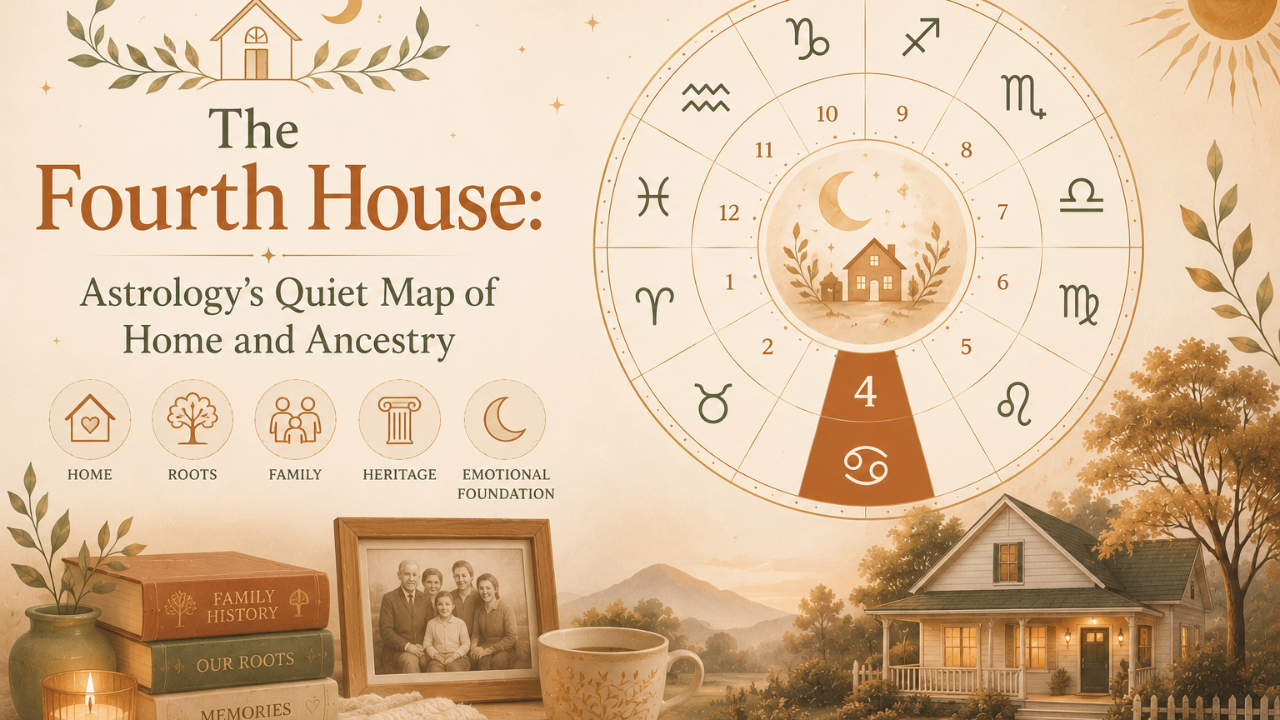
The 4th house governs home, family, roots, and emotional security in a birth chart. It sits at the base of the chart wheel, ruled naturally by Cancer and the Moon, and it colors everything from childhood memory to real estate decisions later in life.
Introduction
Why does one person feel most like themselves in a quiet kitchen, while another only relaxes on the road? A lot of that answer lives in the 4th house. This is the part of a birth chart tied to home, ancestry, and the private self that shows up once the front door closes. Readers who want to understand family patterns, property choices, or that pull toward a certain kind of house will find the 4th house does most of the explaining.
What the Fourth House Represents in Your Birth Chart
Astrologers place the 4th house at the bottom of the wheel, directly opposite the 10th house of career and public life. Where the 10th shows the world what you build, the 4th shows what you go home to. It covers physical dwellings, land, family history, and the emotional base a person operates from.
- Home and physical living space, including houses, apartments, and land
- Family lineage, ancestry, and inherited patterns
- Emotional roots and the sense of psychological safety
- The end of life and private closing chapters, a theme dating back to Hellenistic astrology
- Domestic routines, including renovation, moving, and household comfort
The Angular Point Known as the IC
The cusp of the 4th house is called the Imum Coeli, or IC, Latin for the bottom of the sky. It's one of four angular points in a chart, alongside the Ascendant, Descendant, and Midheaven. Angular houses, meaning the 1st, 4th, 7th, and 10th, mark turning points of action rather than background themes, which is why transits to the IC often line up with actual house moves or family shifts, not just mood changes.
Home, Family, and Ancestral Roots
Cancer rules the 4th house in the natural zodiac, and the Moon is its planetary ruler. That pairing explains why this house reads as emotional territory rather than a simple checklist of address history. It asks what home felt like, not just where it was.
- Early childhood environment and the emotional tone it set
- Ancestral patterns, including family trades, migration, or inherited beliefs
- The parent most tied to nurturing and daily care
- Property, inheritance, and material roots passed down a family line
- Private, unseen habits versus the public persona shown in the 10th house
Parents and Early Environment
Traditional astrologers writing in the Hellenistic period, a lineage historian Chris Brennan has spent years translating and cataloguing, generally linked the 4th house to the father and the 10th to the mother. Modern psychological astrology flipped that reading somewhat, following the influence of early 20th century British astrologer Alan Leo, who reframed the houses around inner development rather than social role.
Jungian-trained astrologer Liz Greene expanded on this by treating the IC as the psychological foundation a person builds an identity on top of, drawing heavily on childhood imprinting. Both readings still circulate today, and most practicing astrologers now treat the 4th house as "the nurturing parent," whichever parent that turns out to be in a given family.
How Zodiac Signs Change the Fourth House Story
The sign sitting on the 4th house cusp shapes how a person expresses these home themes. A Taurus 4th house, for example, tends to want physical comfort and permanence, often showing up as a preference for solid furniture and long-term ownership over renting. An Aquarius 4th house often produces someone who treats home as flexible, sometimes living communally or moving between cities without much attachment to one fixed address.
- Cardinal signs (Aries, Cancer, Libra, Capricorn) push early independence from family
- Fixed signs (Taurus, Leo, Scorpio, Aquarius) favor long-term homes and slow-changing routines
- Mutable signs (Gemini, Virgo, Sagittarius, Pisces) lean toward multiple homes or frequent moves
- Water signs on the cusp intensify emotional memory tied to childhood
- Air signs on the cusp often treat home as a social or intellectual hub rather than a retreat
Cardinal, Fixed, and Mutable Signs at the IC
A client in Austin, Texas, a woman named Priya with a Capricorn 4th house, described leaving her family home at nineteen and never fully unpacking the emotional weight of that decision. Cardinal placements like hers often carry a drive to establish a separate household early, sometimes before they're financially ready, because the pull toward independence outweighs the pull toward comfort.
Planets in the Fourth House and Their Effect on Home Life
Any planet landing in the 4th house adds its own flavor to domestic life. Mars here can point to a household with frequent arguments or a family history involving military service or physical work. Venus tends to soften the home into a gathering space, often with a visible interest in interior design, comparable to the kind of styling seen in shows built around brands like West Elm or Pottery Barn.
- Sun in the 4th: strong identification with family name or home as a personal stage
- Moon in the 4th: deep emotional memory, often a very maternal household
- Saturn in the 4th: a strict or emotionally reserved upbringing, sometimes financial pressure around housing
- Jupiter in the 4th: an expansive, welcoming home, occasionally a large or multi-generational household
- Pluto in the 4th: intense family secrets or transformation tied to ancestry
Fourth House Transits and the Timing of Moves, Renovations, and Family Events
Transiting planets moving through the 4th house often line up with real domestic events. When Saturn transited through many people's 4th houses between 2020 and 2023, home renovation spending and property purchases climbed sharply across the United States, a pattern astrologers pointed to as a textbook Saturn-in-the-4th story: people forced by circumstance to rebuild their relationship with home.
- Saturn transits: structural changes, home repairs, or added family responsibility
- Jupiter transits: a good window for buying property or expanding a household
- Uranus transits: sudden moves or unexpected shifts in family structure
- Pluto transits: deep, sometimes uncomfortable confrontation with ancestral patterns
- Progressed Moon entering the 4th: a natural pull toward settling down or nesting
Wrap Up
The 4th house holds the parts of a chart tied to home, ancestry, and private emotional life, anchored by the IC at the base of the wheel. Its ruling sign and any planets placed there shape whether a person craves permanence or movement, closeness or distance from family history. Reading this house well means paying attention to both the physical address and the emotional inheritance behind it. For anyone trying to understand recurring family patterns or a restless pull toward a certain kind of home, the 4th house is usually where the answer starts.
FAQs
What does the 4th house rule in astrology?
It rules home, family, ancestry, and emotional roots, along with property and the private, unseen side of a person's life.
Is the 4th house about the mother or the father?
Modern astrologers usually link it to the nurturing parent, though traditional Hellenistic astrology associated it with the father and placed the mother in the 10th house.
What happens when a planet transits my 4th house?
It typically coincides with real domestic shifts, such as moving, renovating, family responsibility, or a period of reflecting on childhood and roots.