Your Birth Chart Has a Language, and Vedic Astrology Reads It Fluently
Jun 29, 2026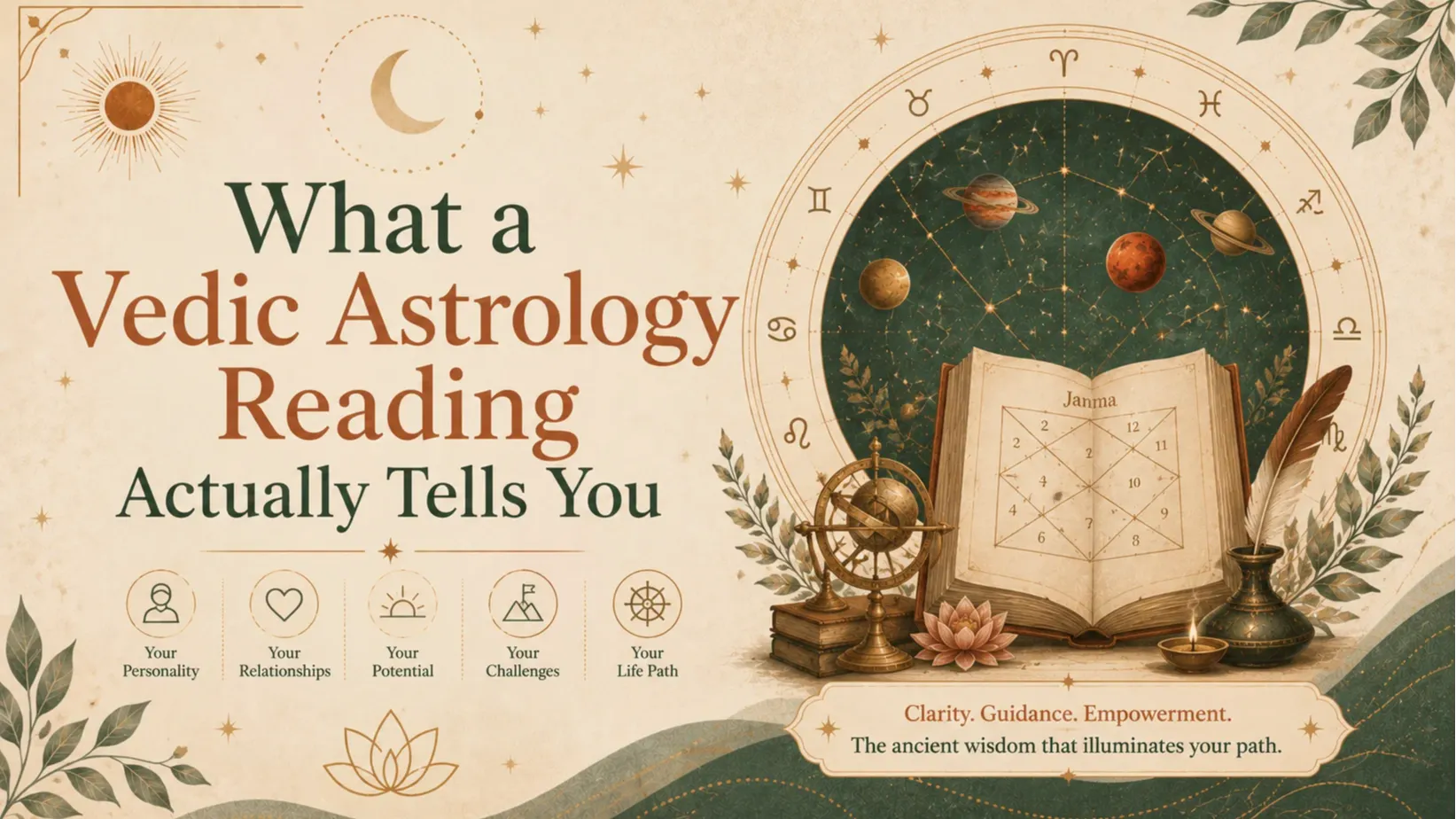
A Vedic astrology reading uses your exact birth time, date, and location to map the sky at the moment you arrived, then interprets how those planetary positions shape your personality, timing, and life themes. Unlike Western astrology, the Vedic system uses the sidereal zodiac, which shifts all signs back by roughly 23 degrees. The result is a reading that often feels more personally precise and timing-specific.
Introduction
What actually happens inside a Vedic astrology reading? Most people walk in expecting vague predictions and walk out surprised by how technical, layered, and strangely accurate the whole system turns out to be. Jyotish, which translates roughly from Sanskrit as "science of light," is a 5,000-year-old discipline rooted in the Vedic tradition of ancient India. It does not guess at your character; it calculates it. This article breaks down how a real reading works, what the practitioner is actually looking at, and how to get something genuinely useful from the experience rather than leaving confused.
How the Sidereal Zodiac Changes Everything
Western astrology places the Sun in Aries beginning around March 21 each year, tied to the spring equinox. Vedic astrology ignores that starting point entirely. It maps planets against the actual backdrop of fixed stars, a system called the sidereal zodiac, using a correction factor called the ayanamsha. The most widely used ayanamsha in practice is the Lahiri ayanamsha, officially adopted by the Indian government for its national almanac in 1955.
This matters because your Vedic Sun sign is often different from your Western one. Someone born on April 10 might call themselves an Aries in Western astrology, but in a Vedic reading they would read as a Pisces Sun, since the sidereal calculation shifts everything back by about 23 to 24 degrees. That is not a contradiction; it is a completely different interpretive framework with different accuracy targets.
The sidereal system tends to track outer cycles, career timing, and life-stage transitions with unusual precision. A practitioner in Delhi or Bengaluru using Parashara software, the gold-standard tool for professional Jyotish work, is calculating in real astronomical time, not symbolic time. That distinction shapes every interpretation that follows.
The Three Pillars Every Practitioner Reads First
The Ascendant, or Lagna
The Ascendant, called the Lagna in Sanskrit, is the zodiac sign rising on the eastern horizon at the exact moment of birth. It sets the entire structure of the chart. Every house, every planet placement, every dasha period is interpreted relative to it. A practitioner will spend significant time on the Lagna lord, the planet ruling the rising sign, because its placement tells them how the person moves through the world.
A Scorpio Lagna with its lord Mars sitting in the 10th house, for example, suggests someone whose public identity and career are driven by intense focus, strategic thinking, and a desire for authority. That is a structural statement, not a personality guess.
The Moon and the Nakshatra System
In Vedic astrology, the Moon carries more weight than in most Western traditions. It rules the mind, emotional nature, and habitual responses. Practitioners assess it not just by zodiac sign but by nakshatra, one of 27 lunar mansions that divide the zodiac into finer segments of 13 degrees and 20 minutes each.
Each nakshatra has a ruling deity, a ruling planet, and a set of themes. The nakshatra Rohini, ruled by the Moon and associated with fertility and material beauty, produces a very different temperament than Ardra, ruled by Rahu and associated with storms and transformation, even though both fall within Taurus or Gemini depending on the exact degree. This level of precision is one reason experienced Jyotish readers can identify specific emotional patterns with a specificity that surprises clients.
Planetary Yogas
A yoga in Vedic astrology is a specific planetary combination that produces a distinct result. There are hundreds of named yogas in classical texts like Brihat Parashara Hora Shastra, one of the foundational texts of the Jyotish tradition attributed to the sage Parashara. Some yogas point to wealth, like Dhana Yoga formed when lords of certain houses combine. Others, like Kemadruma Yoga, flag emotional isolation or financial instability.
The presence or absence of yogas gives a practitioner a fast read on the chart's strongest themes before they even enter the finer details. A chart with Raja Yoga, formed when the lords of trinal and angular houses combine, will read as one with leadership potential, social rise, or both, but the quality of those yogas depends on whether the planets involved are strong, weak, or aspected by malefics.
The Dasha System: How Vedic Astrology Predicts Timing
This is where Jyotish genuinely separates itself from most other predictive systems. The Vimshottari Dasha is a planetary period system spanning 120 years, divided among nine planets in a fixed sequence. At birth, the dasha you are running depends on the Moon's nakshatra position. Each main period (Mahadasha) runs for a set number of years: the Sun's period lasts 6 years, the Moon's 10 years, Mars's 7, and Saturn's longest at 19 years.
Inside each Mahadasha are sub-periods called Antardashas, and inside those are further sub-sub-periods called Pratyantardashas. A skilled practitioner reads these layers to identify not just which life themes are activated but approximately when they peak and resolve. A client in their Saturn Mahadasha, for example, often experiences restructuring in career, health, or relationships, because Saturn rules discipline, limitation, and long-term consequence.
A good real-world example: a professional in their mid-30s going through a career change during their Rahu Mahadasha would not surprise a Jyotish reader, since Rahu periods are classically associated with ambition, disruption, and unconventional moves. The reading frames the disruption as timed, purposeful, and navigable rather than random.
What a Genuine Reading Session Actually Looks Like
Meera, a marketing director in Chicago, booked her first Vedic reading at 37 after a friend recommended a practitioner she had worked with for several years. The session lasted 90 minutes. The practitioner, trained in the Kerala Jyotish tradition, asked for her birth details upfront and said nothing else until the chart was prepared. The first 20 minutes covered the Lagna and Moon sign alone. The next 40 minutes moved through active dashas and transits. The last 30 were questions.
What surprised Meera was not the symbolic language but the specificity. The practitioner identified a career pivot two years earlier and a significant relationship ending around 2019, both of which she confirmed. These were not lucky guesses; they were dasha calculations matching known periods of Rahu and Ketu transits through her 7th and 10th houses.
Not every reading goes this way. A less experienced practitioner might lean on generalities or spend too much time on fixed sign interpretations without addressing current timing. The difference between a competent reading and a vague one usually comes down to whether the practitioner engages with your actual dasha sequence rather than just your natal promise.
What to Prepare Before Your First Vedic Reading
The single most important piece of information is your exact birth time. Even a 10-minute difference can shift the Ascendant and change the entire house structure. Hospital records are the most reliable source. If you only have an approximate time, tell your practitioner, and a good one will use a rectification process, matching key life events to possible chart positions to narrow down the actual birth moment.
Your birth location matters too, down to the city level, because the Ascendant calculation is latitude- and longitude-dependent. Practitioners using software like Kala, Parashara Light, or Jagannatha Hora will enter coordinates directly.
Come with real questions rather than open-ended fishing. The reading covers your whole chart, but focused questions about career timing, relationship patterns, or health cycles produce more useful sessions than "just tell me everything." A good practitioner will cover the structural highlights regardless, but your questions guide where they spend depth.
Common Misreadings and What Beginners Get Wrong
The most frequent mistake beginners make is treating Vedic astrology like a personality quiz. The chart is not a static snapshot of who you are; it is a map of tendencies, timing, and conditions. A malefic planet in a key house is not a sentence. Mars in the 7th house, for example, has a reputation for relationship difficulties, but a well-placed, strong Mars in the 7th can produce an energetic, driven partner. Context always wins over cookbook interpretations.
Another misreading is overweighting the Sun sign. In Vedic astrology, the Moon sign and the Ascendant are primary. Many beginners read their Vedic Sun sign, find it doesn't fit them, and dismiss the whole system. The Sun sign in Jyotish is one layer among many. The Moon sign often feels more immediately recognizable as self-description, and the Ascendant shapes how that self interacts with the world.
Rahu and Ketu, the lunar nodes, also confuse newcomers because they have no physical body but carry enormous interpretive weight. They represent past life karma, obsession, and blind spots in classical Jyotish. A practitioner who skips Rahu-Ketu analysis is leaving out some of the most psychologically rich material in the chart.
Wrap Up
A Vedic astrology reading is a structured, technical conversation between your birth data and a trained interpreter working within a 5,000-year-old system. The sidereal zodiac, the nakshatra system, the dasha periods, and the yoga combinations together produce a reading that covers character, timing, and life trajectory in a way that rewards serious engagement. Arrive with your exact birth details, come with real questions, and treat the reading as a map rather than a verdict. The most accurate reading you will ever get is the one where the practitioner earns your skepticism before your trust.