The Day the Sky Rewires Itself: Uranus's 2026 Move Into Gemini
Aug 11, 2026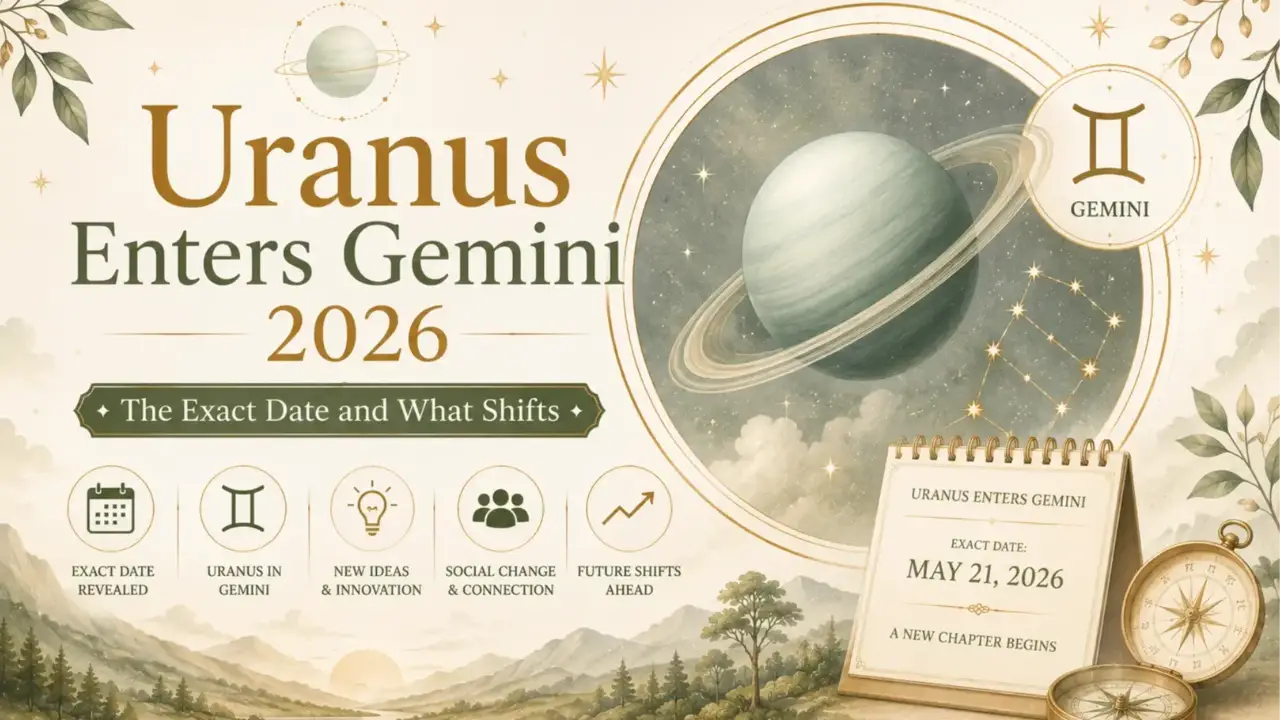
Uranus enters Gemini on April 25, 2026, after a brief preview run from July 7 to November 7, 2025. It stays in Gemini until August 3, 2032, dips into Cancer, then returns from December 12, 2032, to May 22, 2033. The last extended Gemini transit ran from 1941 to 1949, during World War II.
Introduction
What happens to a culture when the planet of sudden change parks itself in the sign of talk, tech, and ideas for seven years? Uranus answers that question again on April 25, 2026, when it crosses into Gemini for the first extended stretch since the 1940s. Anyone tracking their birth chart, or just curious why headlines keep mentioning "outer planet shifts," gets a plain answer here: the exact date, the astronomical mechanics behind it, and what this transit tends to disrupt in daily life.
The Exact Date and Astronomical Mechanics
Uranus completes one orbit of the Sun roughly every 84 years, spending about seven years in each zodiac sign. It first dipped a toe into Gemini from July 7 to November 7, 2025, before retreating back to finish its unfinished business in Taurus.
- Full ingress into Gemini: April 25, 2026
- First stable stretch: April 25, 2026, through August 3, 2032
- Retrograde detour into Cancer: August 2032 through December 2032
- Final return to Gemini: December 12, 2032, through May 22, 2033
- Zodiac system referenced: tropical (the standard used in Western astrology)
This back-and-forth pattern is normal for outer planets near a sign boundary. Saturn does the same thing when it changes signs, and Pluto spent nearly two years easing into Aquarius between 2023 and 2024 before settling in for good. Uranus is simply following its own well-documented rhythm, one that astronomers have charted with precision since William Herschel first identified the planet in 1781.
Historical Precedent: What Happened Last Time
Every Uranus-in-Gemini cycle lands roughly 84 years apart, and each one has coincided with major shifts in how people communicate. The most recent full transit ran from 1941 to 1949, overlapping with World War II, the birth of early computing research, and a global reorganization of media and propaganda.
Before that, Uranus moved through Gemini from roughly 1858 to 1866, a window that included the invention of the transatlantic telegraph cable and the run-up to the American Civil War. Astrologers who study these cycles point to a consistent theme: Gemini rules communication, and Uranus rules abrupt, technology-driven disruption. Put the two together and you get periods when how humans talk to each other changes faster than institutions can regulate it.
None of this means history repeats exactly. It means the underlying pattern, communication systems bending under sudden pressure, tends to show up again.
Why the 84-Year Gap Matters
Because Uranus takes 84 years to complete a full zodiac circuit, nobody alive today experienced the tail end of the 1858 to 1866 transit, and only a shrinking number remember the 1940s directly. That gap is part of why each return feels unprecedented even though the pattern is cyclical.
What This Transit Actually Rules
Gemini governs short-form communication, learning, local travel, and the exchange of information. Uranus governs sudden change, invention, and rebellion against outdated systems. Together, astrologers generally expect activity in a few concrete areas:
- Communication tools and platforms, from messaging apps to social media formats
- Education systems, especially K through 12 curricula and how students access information
- Journalism and media distribution
- Local transportation and short-distance travel infrastructure
- Contract negotiations and everyday agreements, since Gemini also touches paperwork and language
Companies built around fast information exchange, think platforms like X, Substack, or newer AI-driven tools such as those from OpenAI and Google, sit squarely in Gemini's domain. A transit like this doesn't cause specific corporate events on its own, but astrologers watching the 2018 to 2025 Uranus-in-Taurus cycle noted a similar pattern around banking, real estate, and physical resources, areas Taurus rules. The parallel logic applies here: watch the industries tied to the sign, not the planet alone.
The Bigger Astrological Traffic Jam of 2026
Uranus isn't moving alone this year. Saturn entered Aries on February 13, 2026, kicking off a two-year cycle focused on ambition and leadership structures. In early June 2026, Saturn and Neptune form an exact conjunction at 0 degrees Aries, an alignment that last occurred in 1989, the year the Berlin Wall fell.
That means the six-week window between late April and mid-June 2026 carries three separate outer-planet milestones: Uranus settling into Gemini, Saturn locking into Aries, and the rare Saturn-Neptune conjunction. Astrologers describe this kind of clustering as unusual, since outer planets normally shift signs on their own separate schedules, spaced years apart. Whether or not someone follows astrology closely, it's a useful marker for why 2026 keeps getting called a pivotal year in forecasts.
Practical Ways People Are Working With This Shift
A birth chart reader in Austin, Texas, reported that clients born with Gemini rising kept asking the same question in early 2026: why did unrelated conversations at work suddenly feel higher stakes. Her answer wasn't mystical. Uranus transiting the first house often coincides with people becoming more direct, sometimes abruptly so, in how they speak up. She started recommending clients pause before sending reactive emails, a small but concrete adjustment that several reported helped.
Another common mistake shows up in how people plan around the date itself. Early explainer content in late 2025 treated the July to November preview as the "real" ingress, which meant some readers marked their calendars for the wrong year entirely. The fix is simple: April 25, 2026, is the date that starts the multi-year cycle. The 2025 window was a preview, not the main event.
- Track which house Gemini occupies in a personal birth chart to gauge where change concentrates
- Expect faster turnover in communication tools rather than a single dramatic event
- Treat the 2025 preview and 2026 ingress as two separate markers, not the same date
Wrap-Up
Uranus enters Gemini on April 25, 2026, marking its first extended stay in the sign since the 1940s. The transit runs through 2032, dips briefly into Cancer, then closes out in Gemini again by May 2033. History suggests this period tends to accelerate change in communication, education, and media, layered on top of a broader planetary reshuffle already underway in 2026. The exact date matters less than understanding the pattern: a long cycle of disruption in how people talk, learn, and connect, arriving on a schedule that repeats roughly once every 84 years.
FAQs
When exactly does Uranus enter Gemini in 2026?
Uranus enters Gemini on April 25, 2026, after a brief preview transit from July 7 to November 7, 2025.
How long does Uranus stay in Gemini this time?
Uranus remains in Gemini until August 3, 2032, then returns for a final stretch from December 12, 2032, through May 22, 2033.
When was the last time Uranus was in Gemini?
The last extended transit ran from 1941 to 1949, overlapping with World War II and major shifts in global communication technology.