Your Sun Sign Might Be Wrong, According to the Stars Themselves
Aug 18, 2026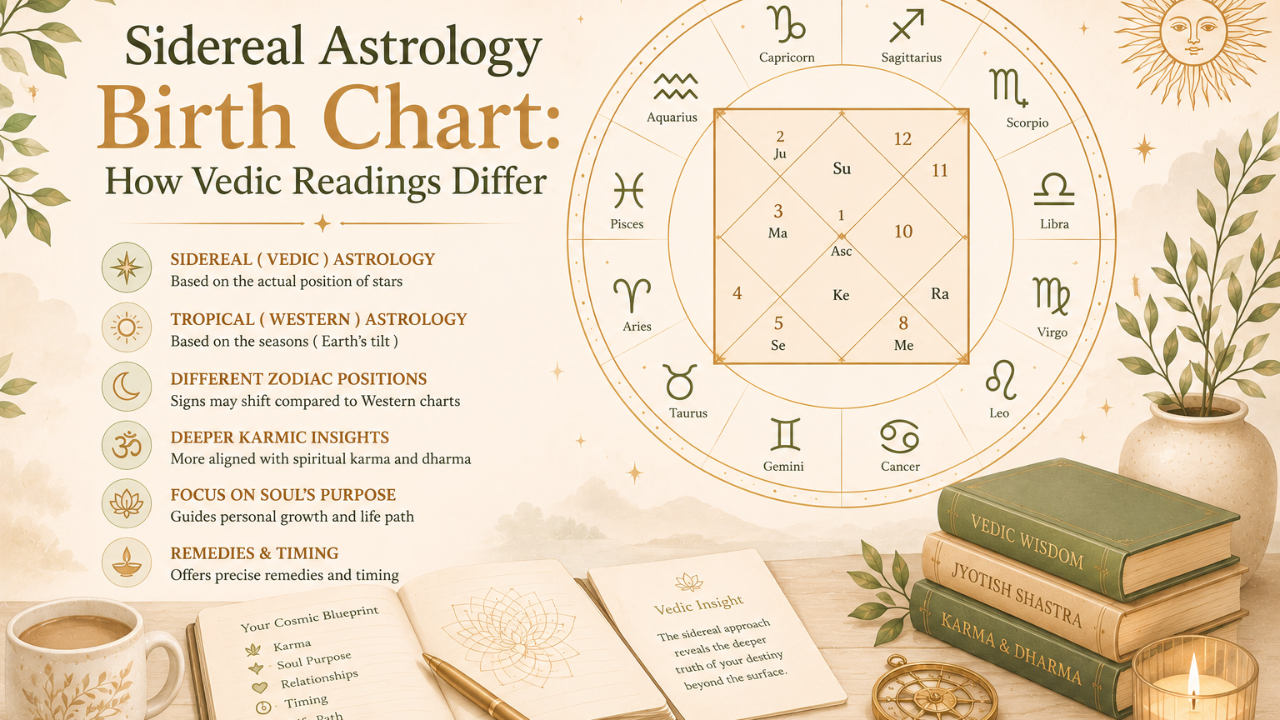
A sidereal birth chart measures planets against the actual constellations instead of the seasons, which is why your sign often shifts back one when you switch from Western astrology to Vedic Jyotish. The gap between the two systems, called the ayanamsa, sits close to 24 degrees in 2026 and grows a little wider every year. Picking a sidereal chart means picking an ayanamsa first, since the calculation depends entirely on which reference point an astrologer uses.
Introduction
Ever run your birthday through a Vedic astrologer and gotten a completely different sign than the one printed in your newspaper horoscope? That's not a mistake. Western tropical astrology and sidereal astrology start from different zero points in the sky, and the distance between them has been growing since the second century. This piece walks through where a sidereal birth chart comes from, how it gets calculated, and what changes once you read one instead of a tropical chart.
The Real Difference Between Tropical and Sidereal Charts
Tropical astrology, the kind behind most newspaper columns and apps like Co-Star, locks the first degree of Aries to the spring equinox every single year. Sidereal astrology, used across most of Jyotish practice in India, Nepal, and Sri Lanka, locks that same starting point to a fixed star instead. The Earth's axis wobbles slowly, a motion astronomers call precession, so the equinox drifts against the star background over time.
That wobble is why the two systems agree less each century. Around 285 AD, tropical Aries and sidereal Aries lined up almost exactly. They've been pulling apart ever since, at a rate of roughly 50.29 arcseconds a year, which adds up to about one degree every 72 years.
Where the 24 Degree Gap Comes From
By 2026 the gap, known as the ayanamsa, sits near 24 degrees. A baby born with the Sun at 5 degrees tropical Aries lands at roughly 11 degrees sidereal Pisces instead. That single number explains almost every "my Vedic sign doesn't match my Western sign" moment people run into online.
How a Sidereal Birth Chart Gets Calculated
A sidereal chart starts exactly like a tropical one: birth date, exact time, and location produce tropical planetary positions using standard ephemeris data. The astrologer then subtracts the ayanamsa value for that birth date from every planet and house cusp. Whatever comes out the other side is the sidereal position.
The catch is that the ayanamsa isn't one fixed number. Different astronomers proposed different reference points over the last century, and each one produces a slightly different chart. India's Calendar Reform Committee settled this question for official purposes in 1955, when a panel chaired by physicist Meghnad Saha, with astronomer N.C. Lahiri serving as secretary, recommended anchoring the zodiac to the star Spica, called Chitra in Sanskrit, fixed at exactly 0 degrees Libra.
That recommendation became the Lahiri ayanamsa, still the default in the Indian government's Rashtriya Panchang and in most Vedic astrology software today, including the widely used Swiss Ephemeris library and the free Jagannatha Hora program.
Reading a Sidereal Chart: Signs, Houses, and Nakshatras
Once the sidereal positions are set, a Jyotish reading pulls in tools tropical astrology doesn't typically use. The chart gets divided into 27 nakshatras, or lunar mansions, each spanning 13 degrees and 20 minutes, and each carrying its own ruling planet and mythology. A Moon at 2 degrees sidereal Taurus, for example, falls under Krittika nakshatra, ruled by the Sun.
Houses matter differently too. Vedic charts almost always use whole sign houses, where an entire sign fills one house regardless of exact degree, while Western tropical charts more often use systems like Placidus that split houses by time. Bring in the Vimshottari dasha system, a 120 year planetary cycle used to time life events, and a sidereal reading starts looking like a different discipline built on the same raw birth data.
A short case makes this concrete. A woman named Meera, born in Pune in 1994 at 6:40 in the morning, checked her Western app and got Sun in Aries. A Jyotish consultation using Lahiri ayanamsa placed her Sun in Pisces, in Uttara Bhadrapada nakshatra, changing which dasha period she was currently running and which house her Sun activated. Same birth data, two legitimate but different frameworks.
Lahiri, Raman, and Krishnamurti: Picking an Ayanamsa
Lahiri isn't the only option, and the differences matter most when a planet sits close to a sign's edge.
- Lahiri (Chitrapaksha): the government-recognized standard, anchored to Spica at 0 Libra, used in most mainstream software by default.
- Raman ayanamsa: popularized by astrologer B.V. Raman, runs about 20 arcminutes smaller than Lahiri, still favored by astrologers trained in his lineage.
- Krishnamurti (KP) ayanamsa: developed by K.S. Krishnamurti for the Krishnamurti Paddhati system, built for precise event timing in horary charts, and detailed in his KP Reader series.
- True Chitra Paksha: a modern adjustment that pins Spica to its exact current astronomical position rather than a fixed historical formula.
Most of these values sit within a degree of each other, so they usually agree on a person's sign. They only disagree, and the disagreement matters, when a planet sits within a degree or two of a sign boundary.
Mistakes People Make Switching to Sidereal
Anyone moving from tropical to sidereal astrology tends to hit the same handful of problems.
- Comparing a tropical Sun sign column to a sidereal reading and assuming one of them is simply wrong, instead of recognizing they're different measurement systems.
- Using a free online calculator without checking which ayanamsa it defaults to, then getting confused when two sites disagree on a planet near a sign edge.
- Ignoring nakshatras entirely and trying to read a sidereal chart with only tropical-style sign meanings, which strips out most of what Jyotish actually analyzes.
- Skipping the exact birth time. A sidereal chart is just as sensitive to minutes as a tropical one, and an unknown or rounded birth time can shift the rising sign and house cusps enough to change the whole reading.
- Paying for a rushed online reading instead of a session with a trained Jyotish consultant, who typically checks the chart against multiple ayanamsa values before flagging any placement that sits close to a boundary.
Wrap Up
A sidereal birth chart isn't a rival opinion to your tropical one, it's a separate coordinate system built on a fixed star instead of the seasons. The ayanamsa, currently near 24 degrees and still growing, explains almost every mismatch between a Western horoscope and a Vedic one. Once the sign shifts, the whole toolkit changes too, from whole sign houses to nakshatras to dasha timing. Get the birth time right, pick an ayanamsa on purpose, and the chart becomes a genuinely different lens rather than a confusing duplicate.
FAQs
What's the difference between a sidereal and tropical birth chart?
A tropical chart measures planets against the seasons, starting Aries at the spring equinox every year, while a sidereal chart measures them against the fixed constellations, which currently puts most planets about 24 degrees earlier in the zodiac.
Which ayanamsa should I use for my birth chart?
Lahiri is the standard used in most Vedic astrology software and by India's national calendar, so it's the safest default unless a specific tradition like Krishnamurti's KP system calls for a different value.
Why is my Vedic sign different from my Western zodiac sign?
The gap between the two systems, called the ayanamsa, has grown to roughly 24 degrees since the two zodiacs lined up around 285 AD, which is enough to shift most people back one full sign in a sidereal reading.