The Planetary Aspects in Jyotish That Create Genuine Magnetic Pull in a Birth Chart
Jun 24, 2026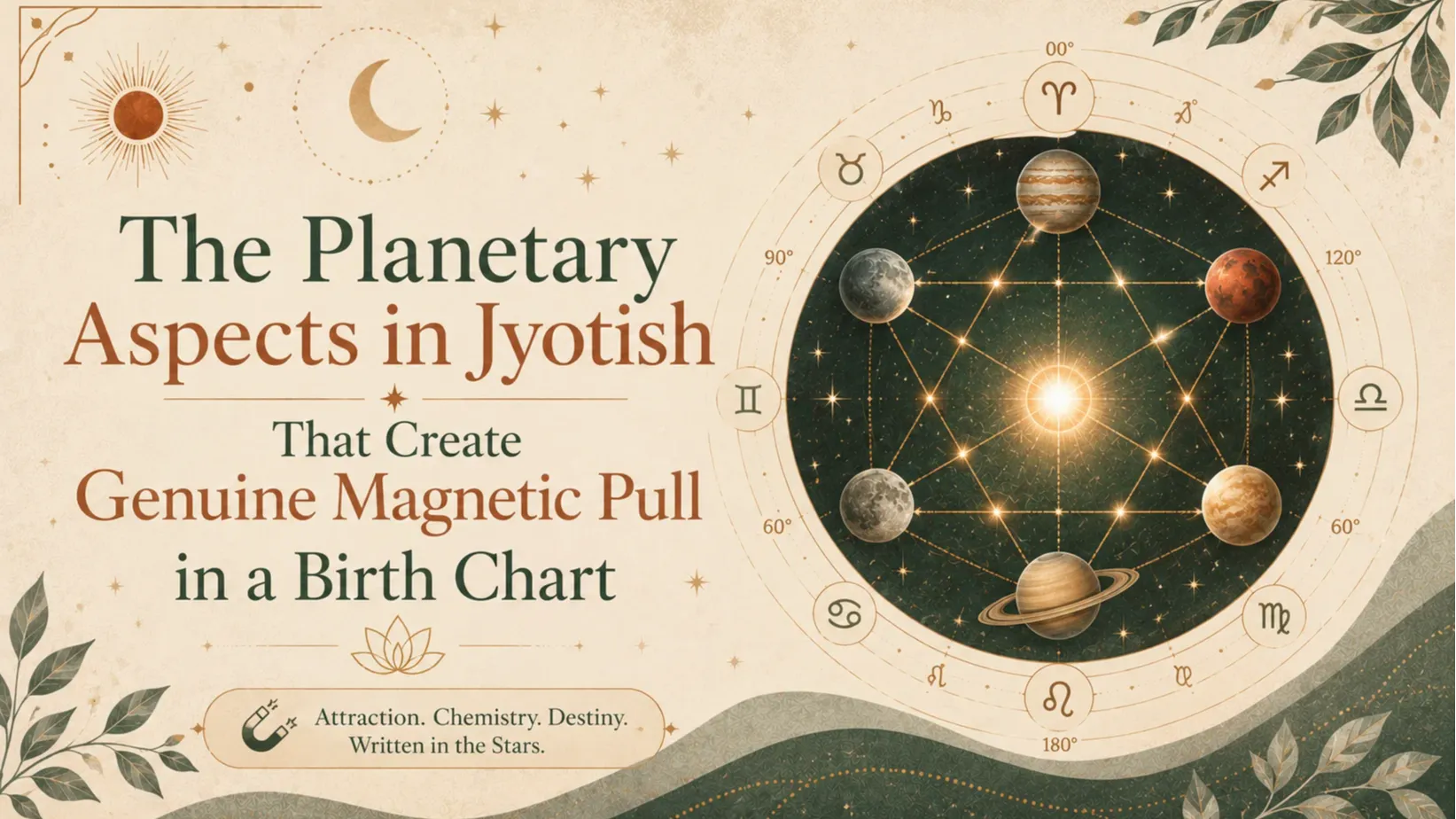
In Jyotish (Vedic astrology), planetary aspects called drishti carry directional force that shapes attraction, ambition, and destiny. Certain aspect combinations involving Jupiter, Mars, Saturn, and Venus are consistently described in classical texts as magnetically potent. Knowing which aspects behave this way and why gives you real analytical power over any natal chart.
Introduction
What makes one person walk into a room and immediately draw all eyes? What makes two strangers meet once and feel an invisible thread connecting them? Jyotish practitioners have been answering questions like these for over two thousand years, and the answer almost always points back to planetary aspects. Graha drishti, the gaze of a planet across the zodiac, is not a metaphor.
It is a structured, rule-based system that determines where a planet's energy travels, what it touches, and what it magnetizes. This article breaks down which Jyotish aspects carry that magnetic quality, why classical authors gave them special weight, and how you can spot them in any chart.
How Graha Drishti Works and Why It Differs from Western Astrology
Every planet in a Jyotish chart casts a full, 100% aspect to the house directly opposite it, the 7th house from its position. That baseline is the same for every graha. What makes the system layered is that Mars, Jupiter, and Saturn each carry additional special aspects beyond the standard 7th-house opposition.
Mars aspects the 4th and 8th houses from its position with full strength. Jupiter casts its 5th and 9th house aspects at full intensity. Saturn reaches the 3rd and 10th houses from where it sits. These are not partial or minor influences. Classical texts like the Brihat Parashara Hora Shastra, attributed to the sage Parashara and estimated to have been compiled between 200 BCE and 200 CE, treat these special aspects as carrying the same 100% intensity as the 7th-house drishti. No other planets in the Parashari system carry more than the basic 7th-house aspect, though some schools, like the Jaimini tradition, apply a different set of rashi drishti rules entirely.
The reason this matters for magnetism is straightforward. When a planet with inherently attractive or commanding energy, such as Venus, Jupiter, or a strong Sun, aspects key houses or personal points in another person's chart, the influence is not diluted. It lands with full weight. That directness is what practitioners mean when they call an aspect magnetic.
Rashi Drishti vs. Graha Drishti
Jaimini astrology applies rashi drishti, meaning signs aspect other signs in a fixed pattern. Movable signs (Aries, Cancer, Libra, Capricorn) aspect all fixed signs except the adjacent one. Fixed signs aspect all movable signs except the adjacent one. Dual signs aspect each other. Graha drishti, the system most students encounter first in Parashari Jyotish, deals with individual planets casting aspects from their natal position. Both systems run simultaneously in a full chart reading, and expert analysts like B.V. Raman and K.N. Rao used both in tandem.
Which Planetary Aspects Carry the Most Magnetic Charge
Jupiter aspecting the ascendant lord or the Moon is one of the clearest signatures of natural personal magnetism in classical Jyotish literature. The 9th-house aspect of Jupiter in particular, which falls on a trine and is aligned with dharmic energy, gives a quality of radiant goodwill that others find immediately appealing. A person born with Jupiter in Scorpio casting its 9th-house aspect onto the Moon in Cancer, for instance, carries an emotional warmth that draws people into confidence quickly.
Venus aspecting the ascendant or its lord by the standard 7th-house drishti creates interpersonal pull of a different kind, the kind rooted in aesthetic harmony and sensory pleasure. When Venus in Taurus sits opposite a Scorpio ascendant, the native tends to carry a quality of refined attraction. Design consultant and Jyotish educator Komilla Sutton has long noted in her published work that Venus-ascendant connections in synastry (chart comparison between two people) correlate strongly with immediate physical and emotional attraction between individuals.
Mars is the most overlooked magnetic planet because Mars is usually discussed in terms of conflict. Yet Mars aspecting the 10th house from its position, which is one of its special drishti points, creates what might be called commanding magnetism. The native does not just attract attention; they pull authority toward themselves. A Mars in Capricorn, where it is exalted, casting that 10th-house special aspect into Libra, produces a presence that others find almost difficult to ignore in professional settings.
Saturn's Slow, Binding Magnetic Pull
Saturn's special aspects to the 3rd and 10th houses from its placement are discussed less in popular Jyotish content but are remarkably potent. Where Jupiter and Venus create immediate warm attraction, Saturn creates a kind of gravitational binding, the sense that a relationship or life path is fated and cannot easily be walked away from.
This quality is described in Saravali, a classical text written by Kalyana Varma around 800 CE, as a certain heaviness that accompanies Saturn's gaze. A Saturn in Aquarius casting its 10th-house aspect onto Scorpio, for example, often correlates with vocations or relationships that feel destined rather than chosen.
The Role of House Placement in Amplifying Magnetic Aspects
An aspect does not exist in isolation. The house a planet occupies shapes the nature of its drishti as much as the planet itself does. A Venus placed in the 5th house (the house of romance, creativity, and children) casting its 7th-house aspect to the 11th house (the house of gains and social networks) creates a very specific type of magnetic attraction: the person gains social currency through creative expression and romantic charisma. This is a different flavour entirely from Venus in the 2nd house aspecting the 8th, which tends to generate magnetic pull around money, inheritance, and deep psychological intimacy.
Jupiter placed in a kendra (angular house: 1st, 4th, 7th, or 10th) is called Hamsa Yoga when it also occupies its own sign (Sagittarius or Pisces) or its sign of exaltation (Cancer). Hamsa Yoga is one of the Pancha Mahapurusha Yogas described in Brihat Parashara Hora Shastra, and it creates an individual whose philosophical and spiritual presence draws people across large distances.
Teachers who embody this placement often build international followings without apparent effort, the kind of case Rao documented in his work with real chart data from Indian public figures.
The 1st, 5th, and 9th houses form the dharma trikona, and any aspect flowing between these houses carries an elevated sense of purpose and destiny. When magnetic planets aspect these houses or the lords of these houses, the magnetic quality extends beyond personal charm into something closer to mission-level attraction, the sense that a person or a path is pulling you toward growth.
Mutual Reception and Parivartana as Magnetic Amplifiers
Parivartana yoga occurs when two planets occupy each other's signs, creating a kind of mutual exchange of energy. When this exchange involves naturally magnetic planets, like Venus in Pisces (exaltation) and Jupiter in Taurus (owned by Venus), the drishti between them creates a loop.
Each planet is simultaneously aspecting the house of the other, and the energy circulates rather than traveling in a single direction. Practitioners in Kerala's Kerala Jyotisha tradition and scholars at the Bharatiya Vidya Bhavan in Mumbai have studied these mutual exchanges extensively as signatures of unusual personal pull.
Reading Magnetic Aspects in Synastry and Compatibility Charts
When two charts are laid side by side, magnetic aspects appear as connections between one person's planet and another person's house cusps or planets. The most consistently noted magnetic synastry pattern in Jyotish is one person's Jupiter falling in or directly aspecting the other's ascendant. The Jupiter person feels naturally beneficial toward the ascendant person; the ascendant person feels seen, blessed, and expanded by the Jupiter person's presence.
Take the case of a client chart from a Chennai-based Jyotish practitioner working in the early 2000s. A woman with Cancer ascendant and her husband with Capricorn ascendant showed a perfect Jupiter opposition: his Jupiter in Cancer fell directly on her ascendant, and her Jupiter in Capricorn mirrored the connection.
Both reported feeling an immediate sense of recognition on first meeting, describing it as a memory rather than a new experience. This is precisely the quality that Parashari texts associate with mutual Jupiter drishti: not passion, but deep familiarity.
Mars synastry aspects function differently. When one person's Mars, particularly through its special 4th or 8th house drishti, touches the other's Moon or Venus, the attraction carries urgency and intensity. It is magnetic in the sense of two poles snapping together. This combination is more volatile than the Jupiter pattern, often dissolving as quickly as it formed if the rest of the charts do not provide stabilizing factors.
Where to Find Reliable Jyotish Resources on Planetary Aspects
For students looking to go deeper, the foundational Sanskrit texts have been translated into English with varying degrees of accuracy. Phala Deepika by Mantreshwara (16th century) provides detailed descriptions of graha drishti effects. The Brihat Parashara Hora Shastra, available in the translation by G.C. Sharma, remains the closest thing to a canonical reference for Parashari aspects. For Jaimini drishti, P.S. Sastri's commentaries are widely respected in the contemporary Indian Jyotish teaching community.
Several structured PDFs circulate in Jyotish study circles covering magnetic planetary combinations specifically. The Jyotish Star, an online periodical, has published downloadable issues covering drishti analysis in detail. Students at the American College of Vedic Astrology and those following courses by Hart de Fouw (author of Light on Life, published 1996) often work with curated PDF reading packets that include annotated extracts from classical texts alongside modern chart examples.
The most durable approach is to build your own reference PDF as you study: one aspect per page, its classical description, three or four real chart examples you have verified, and your own notes on when the rule held and when it required qualification. That document will outperform any generic resource because it reflects actual observational learning rather than theoretical repetition.
Wrap Up
Magnetic aspects in Jyotish are not mystical accidents. They are the result of specific planetary energies, Jupiter's grace, Venus's harmony, Mars's drive, Saturn's weight, landing on sensitive points in a chart with full drishti intensity. The special aspects of Mars, Jupiter, and Saturn are where most of the magnetic power concentrates, especially when those aspects contact the ascendant, the Moon, or the lords of dharmic houses. Studying these patterns in real charts, including your own, is how the system moves from abstract rule to genuine insight.
FAQs
What are the most magnetic planetary aspects in Jyotish?
Jupiter's 5th and 9th house special aspects and Venus's 7th-house drishti to the ascendant or Moon are consistently described in classical Jyotish texts as the most personally magnetic combinations in a natal chart.
How does drishti in Vedic astrology differ from aspects in Western astrology?
In Western astrology, aspects are measured by the angular distance between planets in degrees. In Jyotish, graha drishti is house-based: planets aspect specific houses from their position, and Mars, Jupiter, and Saturn each carry extra special aspects beyond the standard 7th-house opposition.
Where can I find Jyotish PDFs specifically about planetary aspects?
Reliable starting points include the translated editions of Brihat Parashara Hora Shastra and Phala Deepika, Hart de Fouw's Light on Life for English-language Parashari study, and periodicals from the American College of Vedic Astrology, several of which are available as downloadable PDFs.