The Ancient Sky Map That Still Guides Millions of Decisions Today
Jun 25, 2026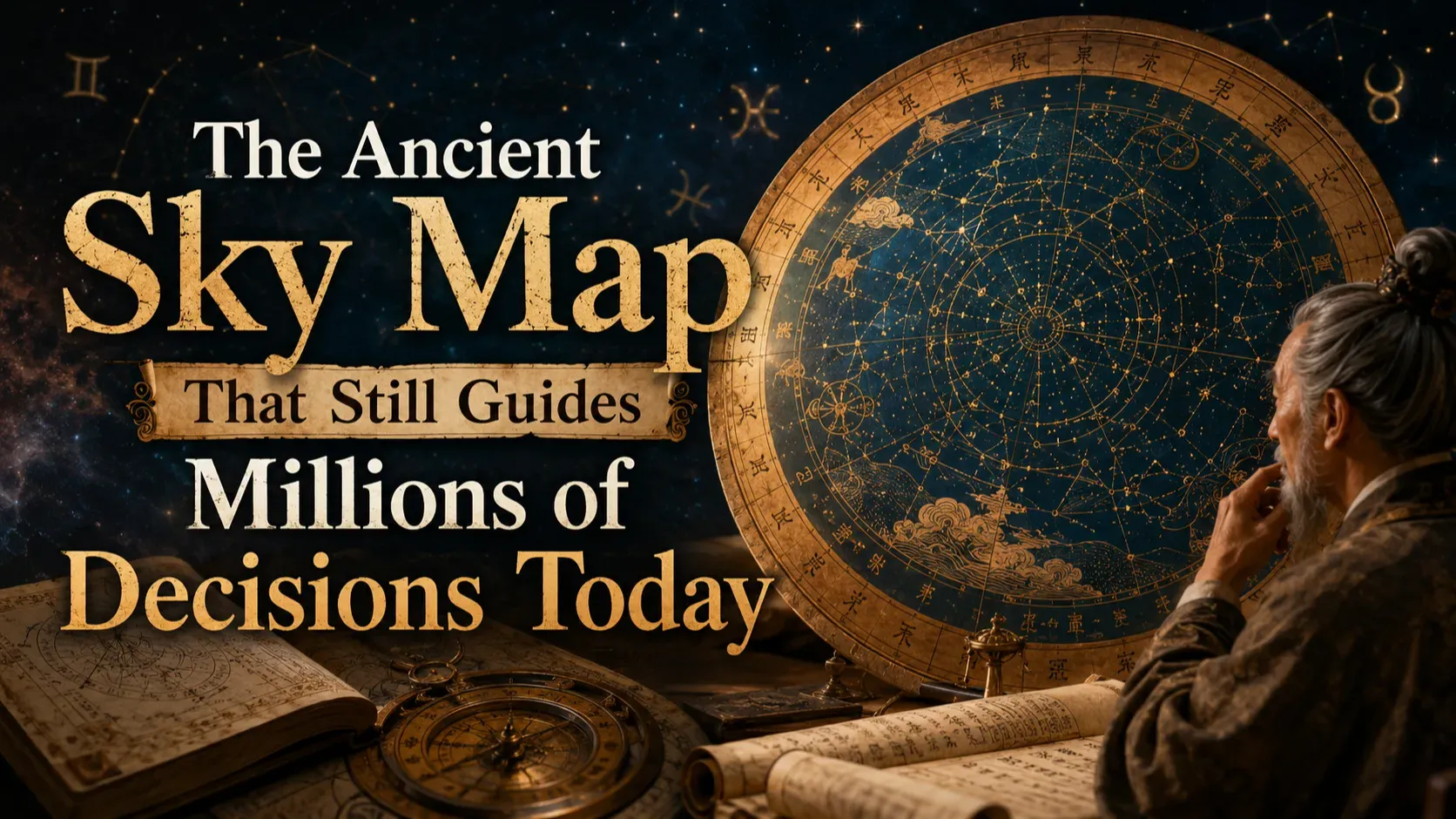
Jyotish, India's classical astrology system, reads a birth chart built from planetary positions at the exact moment of birth to reveal personality traits, karmic tendencies, and life timing cycles called dashas. It uses 27 lunar mansions called nakshatras and 12 houses, making it far more granular than Western sun-sign astrology. Millions of families across South Asia still consult Jyotish charts before marriages, business launches, and major relocations.
Introduction
What if the moment you were born carries a blueprint that trained readers can decode centuries later using the same mathematical rules? That's the core claim of Jyotish, and it's a claim that has survived 5,000 years of scrutiny, reform, and revival. Jyotish is not newspaper horoscopes. It's a detailed astronomical and symbolic system rooted in Sanskrit texts called the Vedas, and it assigns specific planets, signs, houses, and lunar stations to every facet of human life.
This article walks through how the system actually works, what makes it distinct from other astrological traditions, and where it genuinely delivers insight versus where skepticism is warranted.
How Jyotish Differs from Western Astrology
Most people raised outside South Asia encounter astrology through Western sun signs, the Aries-to-Pisces wheel printed in magazines since the 1930s. Jyotish operates on a different astronomical foundation entirely. It uses the sidereal zodiac, meaning it tracks planetary positions against the actual backdrop of fixed stars rather than the seasonal calendar.
Because Earth's axis wobbles over centuries, the two systems currently differ by roughly 23 degrees, a gap called ayanamsha. An Aries rising in Western astrology often becomes a Pisces rising in a Jyotish chart.
This is not a trivial difference. The shift changes the entire chart reading. Priya Kapoor, a Mumbai-based software engineer who switched from Western readings to Jyotish in 2019, reported that her Jyotish chart placed Saturn in her 7th house of partnership, a placement that explained a decade of delayed marriage far more clearly than her Western chart had. That kind of recalibration is common when people first encounter the sidereal system.
Jyotish also weights the ascendant, called the lagna, more heavily than the sun sign. The lagna is the zodiac sign rising on the eastern horizon at the exact minute of birth. Two people born on the same day but four hours apart can have completely different lagnas, leading to charts that read almost like different people's lives. This precision is one reason traditional Jyotish practitioners ask for birth time accurate to within five minutes.
The Sidereal Zodiac and Ayanamsha Explained
The ayanamsha value most widely used in India today is the Lahiri ayanamsha, officially adopted by the Indian government's Calendar Reform Committee in 1955. There are competing values, including the Raman ayanamsha used by astrologer B. V. Raman, founder of the Astrological Magazine, and the Krishnamurti ayanamsha, which underpins the separate KP system of predictive astrology. Each produces slightly different chart readings, which is why two Jyotish practitioners can give divergent readings from the same birth data without either being incompetent.
The Nine Planets and What They Govern
Jyotish works with nine celestial bodies called the navagrahas. These are the Sun, Moon, Mars, Mercury, Jupiter, Venus, Saturn, and two mathematical shadow points called Rahu and Ketu, the north and south lunar nodes. Rahu and Ketu mark the intersection points of the Moon's orbit with the ecliptic and are treated as planets with powerful, irregular influence, especially over obsession, karma, and foreign experiences.
Each graha rules specific areas of life. Jupiter, called Guru or Brihaspati, governs higher education, wealth, spirituality, and children. Saturn, called Shani, rules discipline, delays, laborers, chronic illness, and longevity. Mars, called Mangal or Kuja, covers energy, siblings, property, and conflict. These associations are not arbitrary. They trace back to texts like the Brihat Parashara Hora Shastra, attributed to the sage Parashara and considered the foundational classical source of modern Jyotish.
A planet in its own sign, called swa, or in its sign of exaltation, called uchcha, performs strongly. Venus is exalted in Pisces; Saturn is exalted in Libra. A planet in the sign opposite its exaltation, called neecha or debilitation, is considered weakened. Saturn in Aries is debilitated. These strengths and weaknesses interact with the house position to create the nuanced interpretations that experienced practitioners spend years learning to read.
Rahu and Ketu: The Shadow Planets
Rahu and Ketu always sit exactly opposite each other in a chart, 180 degrees apart. They move backward through the zodiac, spending roughly 18 months in each sign, and their current transit through any house is watched closely in Indian households. The 18-year Rahu-Ketu cycle, called the Rahu mahadasha, is a defining period in Jyotish timing.
Rahu is associated with foreign lands, technology, ambition, and illusion. Ketu is linked to spirituality, detachment, past-life karma, and liberation. Their transits over natal planets, especially the Moon, correlate with the periods that practitioners flag as times of upheaval or sudden change.
The 27 Nakshatras: Jyotish's Most Distinctive Feature
If one element separates Jyotish from every other global astrological tradition, it's the nakshatras. These are 27 lunar mansions, each spanning 13 degrees and 20 minutes of the zodiac, through which the Moon moves in its roughly 27-day cycle. Each nakshatra has a ruling planet, a presiding deity, a symbol, and a set of psychological qualities that color the Moon's expression in a birth chart.
The nakshatra of the birth Moon, called the janma nakshatra, is central to almost every Jyotish reading. It determines the starting point of the dasha timing system. A child born with the Moon in Ashwini, ruled by Ketu, begins life in a Ketu dasha period. A child born with the Moon in Rohini, ruled by Venus, starts in a Venus dasha. This is not symbolic. The nakshatra position of the Moon literally sets the clock for the entire predictive timeline of a person's life.
Nakshatras also drive electional astrology, called muhurtha. Families in Tamil Nadu, Karnataka, and Andhra Pradesh still consult Panchanga calendars, which are traditional almanacs published annually, to find nakshatra-favorable dates for weddings, property purchases, and surgeries. The Panchanga used in Bengaluru may differ from the one in Kolkata because regional astronomical schools, called siddhantic traditions, developed slightly different calculation methods over centuries.
The Dasha System: Jyotish's Predictive Engine
The Vimshottari dasha system is the most widely used predictive tool in Jyotish. It assigns each planet a fixed ruling period: the Sun gets 6 years, the Moon 10 years, Mars 7 years, Rahu 18 years, Jupiter 16 years, Saturn 19 years, Mercury 17 years, Ketu 7 years, and Venus 20 years. The full cycle totals 120 years, considered the ideal human lifespan in classical Indian thought.
Within each major dasha period, each planet also rules a sub-period called an antardasha. A Rahu mahadasha with a Saturn antardasha is generally flagged as a heavy period. A Jupiter mahadasha with a Venus antardasha is typically associated with growth, relationships, and financial opportunity. These periods do not predict events deterministically. They indicate themes and energies that become activated depending on how the natal chart supports them. A strong natal Venus in its own sign of Libra in the 11th house of gains would likely express a Venus antardasha differently than a debilitated Venus in Virgo in the 6th house of service and health.
The 12 Houses and Their Real-Life Domains
The 12 houses in Jyotish, called bhavas, map specific areas of lived experience. The 1st house covers self, body, and personality. The 4th covers mother, home, and emotional security. The 7th covers marriage, business partnerships, and public dealings. The 10th covers career, reputation, and authority figures. The 8th house, often called the most misunderstood bhava, governs inheritance, transformation, chronic illness, occult knowledge, and the circumstances of death.
Planets sitting inside a house, called occupants, and planets ruling a house by sign lordship both carry weight. A chart with Jupiter in the 10th house and Jupiter ruling the 9th house connects luck, higher education, and foreign travel to career success. A chart with Saturn ruling and occupying the 8th house in its own sign of Aquarius often produces a researcher, surgeon, or someone deeply interested in hidden systems. These are patterns, not certainties.
The house system in Jyotish uses the whole sign house method as its traditional foundation, though some modern practitioners adopt the Placidus or equal house systems borrowed from Western astrology. In whole sign houses, whichever sign is rising becomes the entire 1st house, the next sign becomes the entire 2nd house, and so on. This makes chart reading more consistent across different latitudes and easier to teach, which is one reason classical texts favor it.
Where Jyotish Genuinely Works and Where It Falls Short
Jyotish earns the most consistent respect for two things: psychological profiling and timing. The combination of lagna, Moon sign, and Sun sign creates a three-dimensional picture of personality that experienced practitioners read with striking accuracy. A Scorpio lagna with the Moon in Capricorn and the Sun in Virgo tends to produce a reserved, analytical, and strategically ambitious person. That's not magic; it's pattern recognition accumulated over centuries of observation.
Timing through dashas is where practitioners either build or lose their reputation. When a predicted dasha theme does not materialize, the usual explanations are that the birth time was slightly off, or that the natal chart's planetary strengths neutralized or redirected the dasha energy. That flexibility is a genuine criticism. An unfalsifiable prediction is not really a prediction.
Astrologer Sanjay Rath, founder of the Parashara Jyotish Course and a respected figure in contemporary Jyotish education, has long argued that the system's accuracy depends entirely on the precision of birth data and the practitioner's depth of classical training. He has publicly refused to read charts with uncertain birth times, which is a professional standard most casual practitioners skip.
The genuine risk in consulting Jyotish is over-dependence. A family in Hyderabad delayed their daughter's wedding by two years because a practitioner identified a Mangal dosha, a Mars-related astrological flaw associated with marital tension. Whether the Mars placement actually warranted that delay is debatable; what's not debatable is the emotional cost of the wait. Jyotish as a reflective tool is very different from Jyotish as a decision-making authority.
Wrap Up
Jyotish is a coherent symbolic system built on centuries of astronomical observation, classical Sanskrit scholarship, and pattern-based interpretation. Its sidereal zodiac, nakshatra framework, and dasha timing system give it a depth that casual sun-sign astrology simply doesn't attempt. Reading it well requires precise birth data, fluency in classical texts, and years of chart practice. Treat it as one lens among many for self-understanding and life timing, not as the final word on any major decision. The chart describes tendencies; the person makes choices.
FAQs
What is the difference between Jyotish and Western astrology?
Jyotish uses the sidereal zodiac aligned with fixed stars, while Western astrology uses the tropical zodiac aligned with seasons. This creates a roughly 23-degree difference in planetary placements, often shifting a person's sun sign or rising sign by one full sign.
What is a nakshatra in Indian astrology?
A nakshatra is one of 27 lunar mansions spanning the zodiac that the Moon transits during its monthly cycle. The nakshatra position of the birth Moon determines a person's starting dasha period and plays a central role in personality readings and electional astrology.
How accurate is the Jyotish dasha timing system?
The Vimshottari dasha system can indicate life themes and activated areas with notable consistency when the birth time is precise and the practitioner has deep classical training. It describes energetic periods rather than fixed events, so results vary significantly based on the natal chart's planetary strengths.