Cracking Open Your Kundli: A Practical Way to Read a Vedic Birth Chart
Aug 10, 2026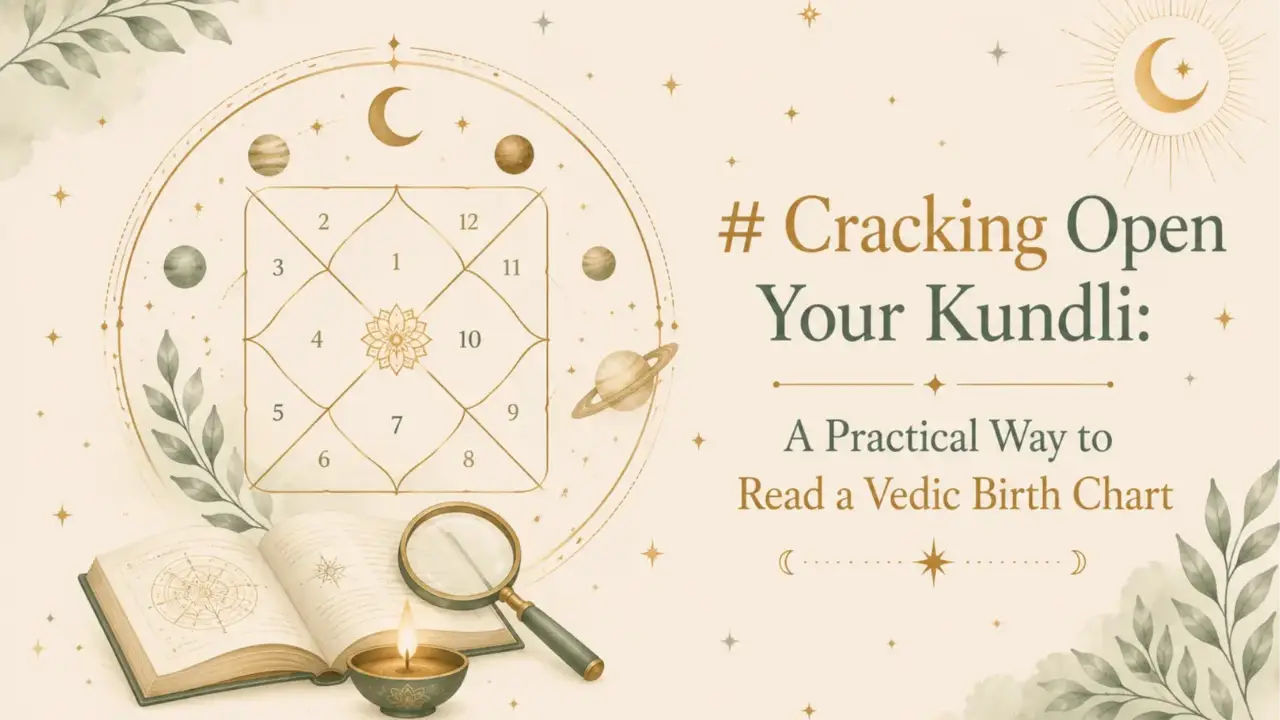
A Vedic birth chart, or kundli, maps twelve houses, nine planets, and twenty seven Nakshatras against the exact moment of birth. Reading one starts with locating the Ascendant, then checking planet placements, house meanings, and the Moon sign, before layering in divisional charts for finer detail.
Introduction
Ever stared at a kundli PDF from AstroSage or a family priest in Varanasi and felt like you were looking at a subway map for a city you've never visited? You're not alone. Vedic astrology, or Jyotish, has a language of its own: Rashis, Bhavas, Grahas, Nakshatras. This piece walks through each layer in order, using a real chart pattern as the working example, so the symbols stop looking random and start telling a story.
The Birth Chart's Foundation: Ascendant and Houses
The Lagna, or Ascendant, is the zodiac sign rising on the eastern horizon at the exact minute of birth. It sits in House 1 and sets the frame for every other reading. A person born at 6:45 AM in Chennai on a specific date might get Leo rising, while a sibling born two hours later could get Virgo instead, because the Ascendant shifts roughly every two hours.
- House 1 (Tanu Bhava): physical body, personality, first impressions
- House 4 (Sukha Bhava): home, mother, emotional comfort, property
- House 7 (Kalatra Bhava): marriage, business partnerships, public dealings
- House 10 (Karma Bhava): career, reputation, authority figures
- House 12 (Vyaya Bhava): losses, foreign travel, spiritual withdrawal
Astrologer B.V. Raman, one of the most cited figures in 20th century Jyotish, argued that house strength often matters more than an isolated planet's sign placement. That's a useful anchor: before judging any planet, check which house it occupies and what that house governs in daily life.
Why the Birth Time Matters So Much
A four minute error in recorded birth time can shift the Ascendant degree enough to change house cusps, which is why hospitals in cities like Pune and Bengaluru now print exact delivery timestamps on birth certificates. Software such as Parashara's Light or Jagannatha Hora recalculates the whole chart if you adjust the time by even a few minutes, so double check the source before trusting any reading.
Mapping the Nine Grahas
Vedic astrology tracks nine planetary bodies: Surya (Sun), Chandra (Moon), Mangala (Mars), Budha (Mercury), Guru (Jupiter), Shukra (Venus), Shani (Saturn), and the two lunar nodes, Rahu and Ketu. Each one carries a personality of sorts, built from centuries of classical texts like Varahamihira's Brihat Parashara Hora Shastra.
- Surya: identity, willpower, father figures, government links
- Chandra: mind, mood, mother, day to day emotional weather
- Guru: expansion, wisdom, higher education, marriage timing for many charts
- Shani: discipline, delay, long term structure, karmic lessons
- Rahu and Ketu: obsession and detachment, often tied to unconventional life paths
A planet's strength depends on the sign it sits in. Jupiter in Cancer is considered exalted, radiating confidence and generosity, while Jupiter in Capricorn is debilitated, often showing up as self doubt around beliefs or finances until the person consciously works through it. This exaltation and debilitation system, called Uccha and Neecha, is one of the first things practicing astrologers check.
Reading Planetary Aspects
Planets don't just sit quietly in their houses, they cast Drishti, or aspects, onto other houses. Mars aspects the 4th, 7th, and 8th houses from its position, which is stronger than the standard 7th house aspect every planet shares. Saturn aspects the 3rd, 7th, and 10th houses. A chart where Saturn sits in House 1 and throws its gaze onto House 10 often points to a career built slowly, brick by brick, rather than through a single lucky break.
The Moon Sign and Nakshatra Layer
Western astrology leans on the Sun sign, but Jyotish gives primary weight to the Moon sign, called Rashi. Someone might be a Sun sign Scorpio in Western terms yet carry a Vedic Moon sign of Taurus, which changes the emotional reading entirely. Alongside the Moon sign sits the Nakshatra, one of 27 lunar mansions spanning 13 degrees and 20 minutes each, from Ashwini through Revati.
Take Rohini Nakshatra, ruled by Venus and symbolized by a cart or chariot, as a working case. A person with Moon in Rohini often shows strong aesthetic instincts and a pull toward stability, which lines up with Rohini's classical association with growth, fertility, and material comfort. Compare that with Moon in Ashlesha, a Nakshatra tied to Mercury and serpent symbolism, which classical texts link to sharp intellect paired with a more guarded emotional style.
- Ashwini: quick starts, healing instincts, restlessness
- Pushya: nurturing, disciplined, considered one of the most auspicious Nakshatras
- Jyeshtha: leadership, protectiveness, occasional isolation
- Revati: gentle, intuitive, transition oriented, the final Nakshatra of the zodiac
Divisional Charts: Going Beyond the Basic Kundli
The main birth chart, called the Rashi chart or D1, gives the broad picture. Serious readings bring in divisional charts, or Vargas, for specific life areas. The Navamsa chart, or D9, is the second most referenced chart after D1 and focuses heavily on marriage, spiritual inclination, and the true strength of planets.
A planet that looks weak in the D1 chart can gain strength, called Vargottama, if it lands in the same sign across both D1 and D9. This is a detail many beginner readings skip, yet experienced Jyotishis treat it as a meaningful confirmation signal rather than a footnote. The Dashamsha chart, or D10, narrows in on career, while the Saptamsha, or D7, focuses on children and legacy.
A Real World Reading Pattern
Consider a chart pattern common in career consultations: Ascendant in Capricorn, Saturn placed in House 10 in its own sign of Aquarius, and Moon in Uttara Ashadha Nakshatra. Astrologers reading this combination typically flag steady, long term career growth, often in structured fields like law, administration, or engineering, with recognition arriving later in life rather than early. This mirrors a well documented pattern in classical Jyotish where Saturn ruling and occupying an angular house tends to reward patience over speed.
Vimshottari Dasha: Timing the Events
Planet placement tells you what a chart's tendencies are, but the Vimshottari Dasha system tells you when those tendencies activate. This 120 year cycle divides life into planetary periods, or Mahadashas, based on the Moon's Nakshatra at birth. A Jupiter Mahadasha, lasting 16 years, often brings expansion in education, family, or finances, while a Saturn Mahadasha, lasting 19 years, tends to demand discipline and can feel heavier if Saturn sits poorly in the natal chart.
- Sun Dasha: 6 years, ego and authority themes
- Moon Dasha: 10 years, emotional and domestic focus
- Rahu Dasha: 18 years, ambition, unconventional gains, some instability
- Venus Dasha: 20 years, the longest period, tied to relationships, comfort, creative work
Within each Mahadasha sit smaller Antardashas, sub periods that fine tune the timing further. A Saturn Mahadasha with a Venus Antardasha, for instance, often softens Saturn's usual heaviness with periods of relationship stability or financial recovery.
Wrap-Up
Reading a Vedic birth chart isn't about memorizing every rule at once, it's about layering information in order: Ascendant first, then house meanings, planetary placements and aspects, the Moon sign and Nakshatra, and finally the divisional charts and Dasha timing. Each layer refines the last one rather than replacing it. Treat early readings as pattern recognition practice, not fixed predictions, and the whole system starts to feel less like decoding a foreign script and more like reading a detailed, personal weather report.
FAQs
What is the difference between a Vedic birth chart and a Western birth chart?
Vedic astrology uses the sidereal zodiac and centers readings on the Moon sign and Nakshatra, while Western astrology uses the tropical zodiac and centers on the Sun sign.
Can I read my own birth chart without an astrologer?
Yes, with an accurate birth time and free tools like AstroSage or Jagannatha Hora, you can identify your Ascendant, planet placements, and Moon Nakshatra on your own, though nuanced timing work usually benefits from an experienced reader.
Why does birth time accuracy matter so much in Vedic astrology?
The Ascendant and house cusps shift with even small changes in birth time, so an inaccurate time can produce a chart with the wrong house placements and misleading con