The 8th House in Jyotish Holds Secrets Most Charts Never Fully Explain
Jun 23, 2026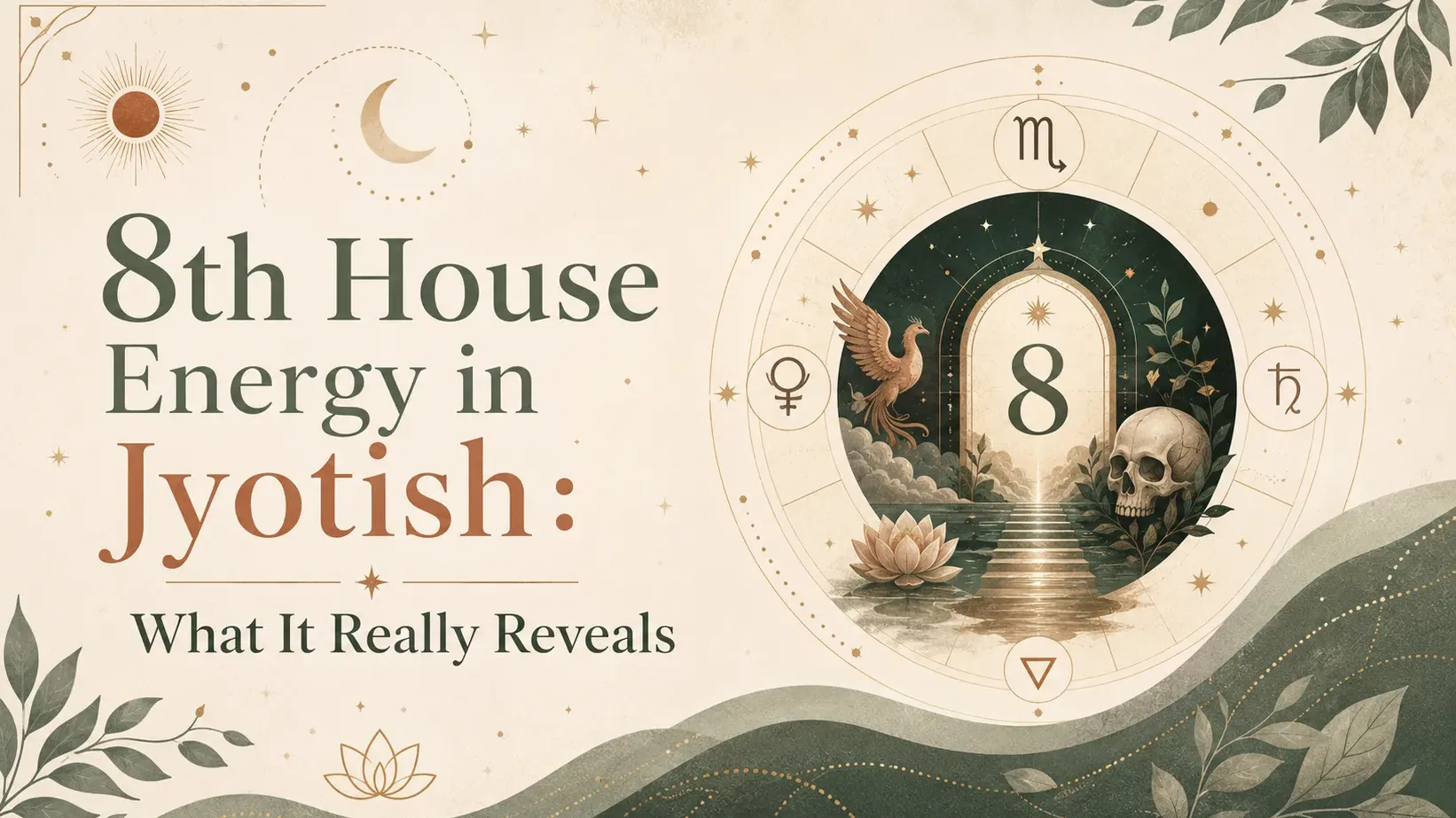
The 8th house in Jyotish governs transformation, longevity, hidden resources, occult knowledge, and sudden upheavals. Planets placed here intensify these themes dramatically, for better or worse. Reading this house well requires understanding its lord, occupants, and the nakshatra involved.
Introduction
What if one house in your birth chart quietly shaped your entire relationship with power, money, and mortality? The 8th house in Jyotish, called Ayu Bhava or the house of lifespan, is one of the most misunderstood placements in Vedic astrology. Students often dread finding planets here, while seasoned practitioners know it holds some of the chart's most potent energies. This piece breaks down exactly what the 8th house energy means, how different planets shift its expression, and why it deserves far more nuanced attention than "bad house, avoid."
What the 8th House Actually Governs in Jyotish
The classical Sanskrit texts, including the Brihat Parashara Hora Shastra written around 600-700 CE, categorize the 8th house under the Dusthana group alongside the 6th and 12th. Dusthana literally means a place of difficulty, but that translation misses the fuller picture. The 8th house rules ayu (longevity), alpa or dirgha (short or long life), secret matters, inheritance from in-laws, unearned wealth, accidents, chronic illness, research, and occult sciences.
Think of it this way: the 8th house is where life tests the soul with what it cannot control. Sudden windfalls, unexpected losses, inheritance disputes, near-death experiences, and deep psychological transformations all fall under its domain. In 2019, financial astrologer Yenbeeyes published research on lottery winners in India showing a strong pattern of 8th house activation through Dasha periods, which confirmed what classical texts had described centuries earlier.
The sign on the 8th house cusp matters enormously. Scorpio as the natural 8th house sign in the Kalapurusha chart (the cosmic body map used in Jyotish) connects the house to Mars's intensity and Ketu's spiritualizing influence. When Aries sits on someone's 8th house, Mars rules that house and adds an aggressive, fast-moving quality to transformations. Taurus on the 8th, ruled by Venus, often brings hidden financial assets or connections to family wealth held secretly.
The Role of the 8th House Lord and Its Placement
Where the 8th lord sits tells you more than the house itself. If the 8th lord is placed in the 1st house, the native often carries visible marks of transformation, sometimes physical scars, or a personality shaped by early brushes with loss or near-crisis. B.V. Raman, one of the most cited Jyotish scholars of the 20th century, noted in his works that the 8th lord in Kendra (1st, 4th, 7th, or 10th house) creates a strong connection between transformation and the person's core life pillars.
When the 8th lord sits in the 11th house of gains, unexpected inheritances and windfalls appear frequently. The opposite is true when it occupies the 12th house: hidden losses, expenses tied to illness, or spiritual expenditures drain resources in ways that aren't always visible on the surface. These are not generic warnings but observable patterns that repeat across thousands of charts when studied systematically.
The 8th lord in its own sign or exaltation is a specific condition worth noting. Mars exalted in Capricorn placed in the 8th house of a Cancer ascendant chart, for example, gives a surgeon's precision and often a long career in medicine, forensics, or research. It's one of those combinations where the "difficult" house actually produces professional excellence when dignity is high.
Planets in the 8th House and How Each One Behaves
Sun in the 8th House
The Sun here dims its natural brightness, since the 8th is 12th from the 9th house of fortune. People with Sun in the 8th often have complicated relationships with their father, authority figures, or their own ego identity. The positive side is a strong drive toward research, depth, and uncovering hidden truths. In mundane Jyotish, Sun transiting through the 8th house (roughly around February to March each year for Aries Lagna natives) often marks a period of introspection or health checks.
Moon in the 8th House
This is considered one of the more emotionally challenging placements. The Moon, which governs mind and emotions, sits in a house of uncertainty and sudden shifts. Psychologically, Moon in the 8th often produces intuitive, perceptive individuals with a natural pull toward psychology, grief work, or healing professions. Vedic astrologer K.N. Rao observed in his teachings that Moon here frequently appears in charts of people drawn to meditation and inner transformation, not as escape, but as genuine practice.
Mars in the 8th House
Mars is considered a natural karaka (significator) for the 8th house themes of accidents, surgery, and sudden events. In its own sign (Aries or Scorpio on the 8th) or exalted in Capricorn, it performs well and can indicate surgical skills, engineering precision, or physical resilience. In enemy signs or afflicted by Rahu, it heightens accident-prone tendencies, particularly around vehicles or sharp instruments.
Saturn in the 8th House
Saturn in the 8th is one of the more discussed combinations for long life (dirgha ayu), especially when Saturn is well-placed by sign and aspect. Saturn naturally governs longevity, and in the house of lifespan, its slow, enduring energy often extends life and deepens the native's relationship with discipline, aging, and mortality. The downside is chronic health issues appearing in old age or a tendency toward prolonged, difficult periods during Saturn Dasha or Sade Sati.
Rahu in the 8th House
Rahu amplifies whatever house it occupies, and in the 8th, this creates an obsessive pull toward the occult, hidden knowledge, or foreign inheritances. Many practitioners of astrology, tarot, tantra, and energy healing have Rahu in the 8th. The shadow side is an appetite for hidden information that can cross ethical lines, or a pattern of sudden, chaotic changes in life circumstances that keep repeating until addressed consciously.
Ketu in the 8th House
If Rahu obsesses, Ketu renounces. Ketu in the 8th is associated with past-life wisdom around death and transformation, and this often manifests as a person who seems unusually calm about mortality or who has had spiritual experiences around near-death events. Ketu here is considered spiritually significant in Tantric traditions. The challenge is detachment from the material side of 8th house themes, which can create confusion around inheritance, insurance, or financial planning with a spouse.
The 8th House and Unearned Wealth (Akasmika Dhana)
One of the least-discussed but practically important aspects of the 8th house is its connection to akasmika dhana, which translates roughly to unexpected or unearned money. This includes inheritance, insurance payouts, lottery winnings, spouse's undisclosed assets, and money from wills or legal settlements. When the 8th lord connects with the 2nd lord (house of personal wealth) or the 11th lord (house of gains), the chart often shows someone who receives large sums without traditional labor.
A case worth noting: an astrologer working in Pune documented a client in 2018 whose 8th lord Jupiter in Pisces conjoined the 11th lord Venus in Pisces, forming a Pancha Mahapurusha yoga in the 11th house. The client received an unexpected inheritance from a distant relative in the UAE three years later during Jupiter Dasha, which matched the classical prediction almost precisely. The 8th house was not the villain in that chart. It was the source of transformation and financial elevation.
The connection between the 8th house and spouse's wealth is also meaningful. The 8th house is the 2nd from the 7th (house of marriage), so it naturally represents the financial resources brought into the partnership from the spouse's side. Couples where one partner has strong 8th house placements often experience shared financial transformation, either through inheritance, joint investment, or life insurance.
The 8th House in Dashas, Transits, and Timing Events
Jyotish timing systems bring the 8th house to life in ways that static chart reading cannot. The Vimshottari Dasha system assigns periods to planets, and when someone runs the Dasha of the 8th lord, the themes of that house arrive with full force. These periods are not curses. They are invitations to engage with what has been hidden.
During a Rahu Mahadasha for someone with Rahu in the 8th, research into family secrets, sudden career shifts, or profound spiritual experiences frequently surface. Astrologers in the Krishnamurti Paddhati (KP) system pay close attention to the sub-lords of the 8th house cusp to determine whether a surgical outcome will be positive or complicated, a method used by many practicing medical astrologers in South India.
Saturn transiting the 8th house is called Ashtama Shani and is considered one of the more challenging transit periods in Jyotish. For Aries Lagna or Moon in Aries, Saturn's transit through Scorpio (which it completed in 2017) brings delays, health concerns, and forced restructuring. The recommendation from experienced practitioners is not to resist but to consolidate: reduce financial risk, avoid unnecessary travel, and prioritize health screenings during this window.
Practical Ways to Work With 8th House Energy
Gemstone and mantra remedies for 8th house challenges depend heavily on the planet involved and the chart as a whole. A blanket prescription of a blue sapphire for Saturn in the 8th, for example, is considered risky without a full chart assessment, since Saturn rules the 8th in some charts and the 5th in others. Context always determines the remedy.
Practices associated with the 8th house in Jyotish include meditation on Mrityunjaya Mantra (a Vedic mantra dedicated to Shiva in his role as the conqueror of death), fasting on Tuesdays for Mars-related 8th house afflictions, and charitable donations to hospitals or hospice care as a dharmic remedy for Ketu placements. These are traditional prescriptions, and their effect is considered cumulative rather than immediate.
For people running 8th house Dasha periods, Jyotish teachers often advise using the period for deep study, research projects, psychological healing, or spiritual practice, since the house supports inward movement naturally. Fighting the tide of an 8th house Dasha by pushing for external achievement often meets resistance, while inner work produces lasting gains.
Wrap Up
The 8th house in Jyotish is not a house to fear but a house to read carefully and respect deeply. It governs the very forces that shape a life most profoundly: how long it lasts, what it inherits, and what it must shed to grow. Planets here speak about transformation on a level that surface-level astrology rarely touches. The most practical takeaway is this: know your 8th house lord, its placement, and when its Dasha arrives, because that period will be the most defining chapter in any chart.
FAQs
Is the 8th house always bad in Jyotish?
No. The 8th house is a Dusthana but carries significant positive potential, especially for research, inheritance, spiritual depth, and longevity when planets are dignified and well-aspected.
Which planets do well in the 8th house in Vedic astrology?
Saturn (for longevity), Mars (in own sign or exaltation), and Ketu (for spiritual insight) are traditionally considered to perform relatively well in the 8th house compared to Sun or Moon.
What does the 8th house lord in the 1st house mean in Jyotish?
It creates a strong link between the native's identity and 8th house themes, often producing people drawn to occult sciences, healing professions, or marked by early transformative experiences that shape their entire personality.